




It’s Always Been
About The People
As a student, Naomi Cahn, Class of 2012, had teachers who met her where she was. As Kehillah’s technology manager, she’s returning the favor.
When Naomi Cahn, Class of 2012, walked back into Kehillah this July as its new technology manager, the first thing she noticed was what was missing. The school building’s painted orange-yellow walls and brown carpet from her student days were gone.
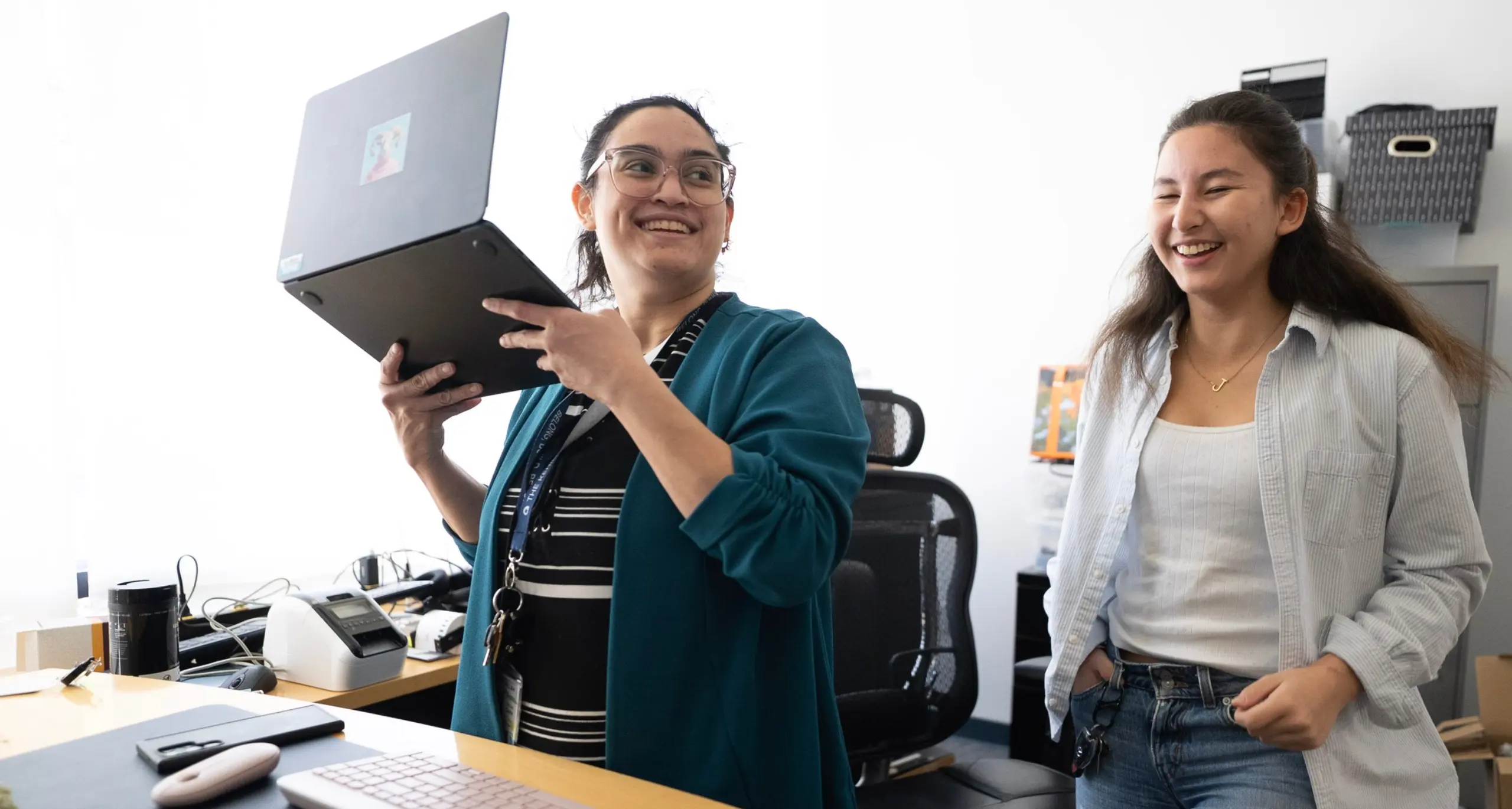
But as she welcomed the new school year, she realized the school still felt the way it did 14 years ago. “It felt like home,” she says of her time here, “and I felt like a lot of what we were taught here was in service of going forward and making the world a better place.”
Finding her people
Long before she had a title, Naomi was the one people called when something broke. Growing up in San Jose, in the heart of Silicon Valley, she watched computers move into the family home and tinkered with every program she could find. “My interest in tech grew out of my want to help,” she says.
When she first arrived at Kehillah, the only student she knew was her cousin. That changed fast. She made friends across grade levels, played acoustic guitar at school concerts, and spent most of high school on the yearbook staff. Classes were small enough back then that juniors and seniors traveled to Israel together, so her first trip there was with friends from two grades.
Having an aunt and uncle on the faculty wasn’t why her teachers knew her. Her teachers made a point of knowing every student, Naomi included. Honors physics was her toughest class. She went to every office hour she could, and when college applications came around, that physics teacher was the one she asked for a recommendation.
“I felt like I had the guardrails, and at the same time, I had the support I needed here, even though it wasn’t the best class for me at the time,” she says.
Her road into tech
Naomi’s path after graduating from Kehillah took some turns, and each one taught her something she still uses today. She got her start in tech with a part-time college job in classroom and desktop support, and she was eventually promoted to field work, heading into classrooms to help professors.
“Remove the tech from it, and it is all about how you interact with people,” she says.
She went on to become a tech support engineer at Barracuda Networks, learning all six products in its email security suite in under six months, then moved to CrowdStrike. Today, she’s finishing her bachelor’s degree in cloud and network engineering at Western Governors University while working full time.
Repairing the world, one fix at a time
Through every job, she carried a value she first learned at her synagogue: tikkun olam, the Jewish value of repairing the world. Girl Scouts added another lesson: leave places better than she found them. “I think that should apply to people, too,” she says.
That’s how she approaches her job at Kehillah now.
When a colleague tells her they’re bad with technology, or warns that they’ll be calling her a lot, she doesn’t flinch. If a device or program isn’t intuitive for the people using it, she says, “That’s not a user problem.”
As Kehillah’s technology manager, she works to make each fix stick, so the next time someone hits the same snag, they feel ready to handle it themselves. Early this fall, she sent teachers a survey about the tools and software they need in their classrooms. As she sees it, her job is to clear the way so that Kehillah teachers can focus on what they do best: teaching our students.
Seeing it from the other side
Now that she’s on staff, Naomi sees how much her colleagues do behind the scenes to give every Kehillah student a rigorous education built around who they are.
After meeting every single student and drawing on what he knows about each one, High School Director Richard Brownstone builds every student’s schedule himself. At a much bigger school, Naomi points out, there wouldn’t be “one person knowing, basically, just about everything there is to know about every single student.”
She sees the same care from Dean of Students Zoë D’Souza, Rabbi Dennis Eisner, Interim Head of School, and the entire Kehillah staff and faculty.
“Once I absorbed the community here as faculty, I realized just how much effort the administrators and teachers put into supporting the students, well beyond any way they’ll ever know,” Naomi says. “It’s really beautiful.”
Full circle
Years later, the class Naomi worked hardest to still stick with her. Talking with a group of 9th graders about guitar this year, she found herself explaining how a string’s length, tension, and thickness change its frequency to produce different notes.
Her advice for students curious about tech, or about any path that doesn’t run in a straight line, comes back to that same instinct.
“It does not hurt to pursue knowledge for the sake of the knowledge itself—to know it, to learn it, and to learn it by doing,” she says. “This applies to anything, not just tech. If you don’t have any curiosity for what you’re doing, for what you’re learning, for what you’re working on, it doesn’t matter how much you’re getting paid.”
For Naomi, the best outcome of any fix is a person who walks away more confident, whether or not they remember who helped.
“They don’t need to remember me. What I want them to remember is how they felt.”
Even though the building’s walls are a different shade now, Naomi says her reason for coming back to Kehillah comes down to the same thing it always has.
“It’s really not about the tech—it’s about the people,” she says. “You’ve got the building, which kind of feels like home, but it’s not Kehillah without the community, without the actual people in it.”